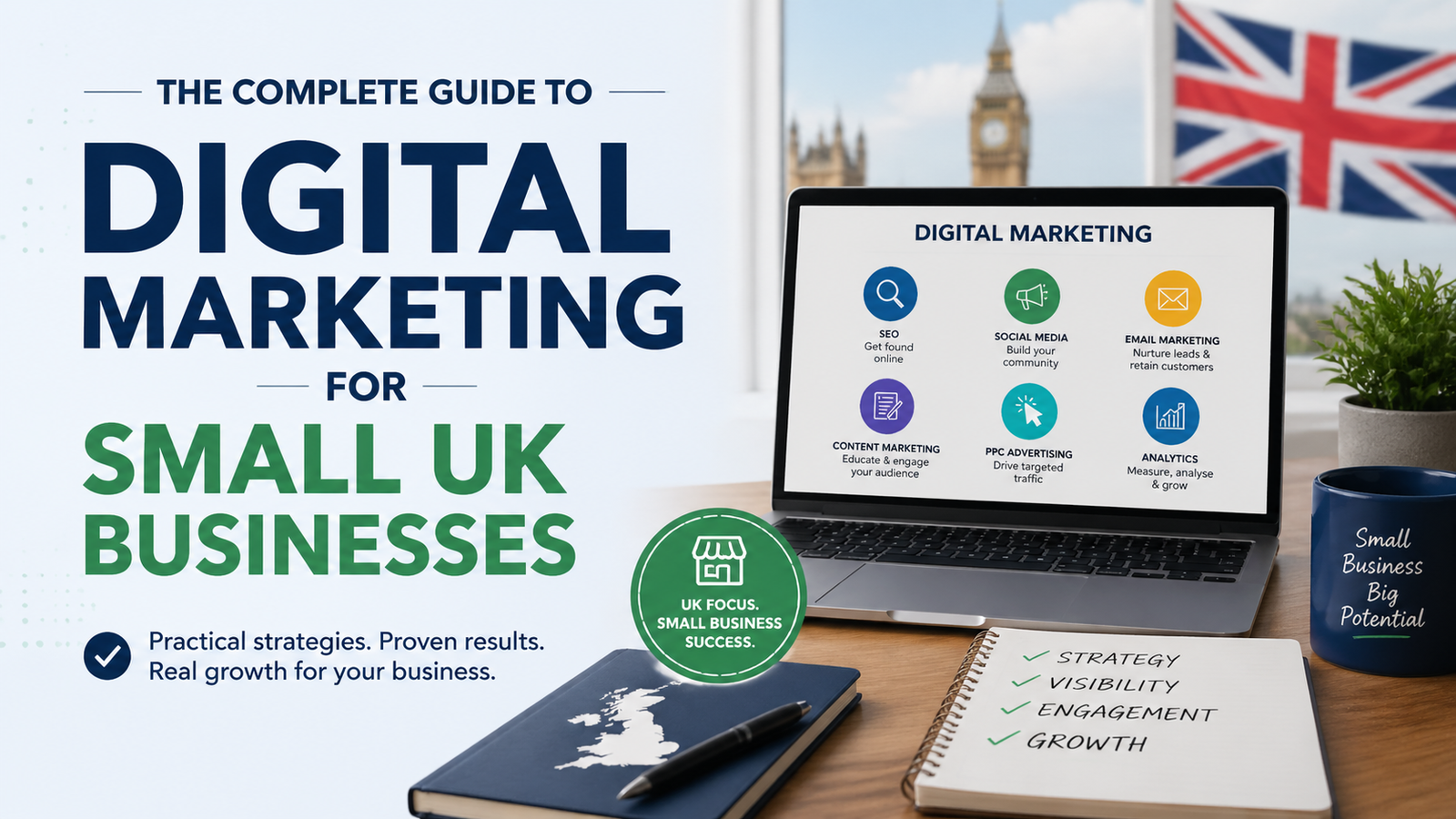
Running a small business in the UK has never been more competitive or more exciting. With over 5.5 million small businesses operating across the United Kingdom, standing out online is no longer optional. It’s survival.
Whether you’re a local tradesperson in Leeds, a boutique retailer in Bristol, or a start-up founder in London, this guide will walk you through every pillar of digital marketing in plain English so you can attract more customers, generate more leads, and grow your revenue without wasting a penny.
At Golden Egg Marketing, we’ve spent over 20 years helping UK small businesses do exactly that. This is the same advice we give our clients now available to you, completely free.
1. What Is Digital Marketing?
Digital marketing is the umbrella term for any marketing activity that takes place online or through digital channels. This includes:
- Search engines: (Google, Bing)
- Social media platforms: (Facebook, Instagram, LinkedIn, TikTok)
- Email campaigns:
- Your website and blog:
- Online advertising: (Google Ads, Meta Ads)
- Video platforms: (YouTube)
Unlike traditional marketing, think leaflets, newspaper ads, or billboard hoardings, digital marketing gives you the ability to target specific audiences, track every penny you spend, and measure exactly what’s working. For small businesses with tight budgets, this precision is invaluable.
2. Why Small UK Businesses Can’t Afford to Ignore Digital Marketing
Here are some hard facts every UK small business owner needs to know:
- 97% of consumers use the internet to find local businesses
- 76% of people who search for a local business on their smartphone visit one within 24 hours
- Businesses that blog generate 55% more website visitors than those that don’t
- Email marketing delivers an average return of £36 for every £1 spent
- 72% of consumers who searched for a local business visited a store within 5 miles
Gone are the days of relying solely on word-of-mouth or walk-in footfall. Your customers are online searching Google, scrolling Instagram, and reading reviews, before they ever pick up the phone. If you’re not visible, your competitors are getting those calls instead.
Digital marketing levels the playing field. A well-executed SEO strategy or PPC campaign can help a small independent business compete with far larger rivals and win.
3. Building Your Digital Foundation: Website Design
Before you invest in any form of digital marketing, you need a solid foundation: a professional, high-converting website.
Your website is your digital shopfront. It works for you 24 hours a day, 7 days a week, 365 days a year even while you sleep. But here’s the key: it needs to do more than simply look nice.
What Makes a High-Converting Small Business Website?
Speed: Google research shows that 53% of mobile visitors abandon a website if it takes longer than 3 seconds to load. Every second of delay costs you customers.
Mobile Responsiveness: More than half of all UK web traffic now comes from mobile devices. If your site isn’t mobile-friendly, you’re losing half your potential customers before they even read a single word.
Clear Navigation: Visitors should find what they need within 2–3 clicks. A confused visitor is a lost customer.
Strong Calls to Action (CTAs): Every page should guide visitors towards a specific action: “Get a Free Quote”, “Call Us Today”, “Book Your Appointment”. Don’t make people guess what to do next.
Trust Signals: Customer testimonials, Google reviews, accreditations, and case studies all tell new visitors that real people have used your services and loved them.
On-Page SEO: Your site needs to be technically optimised so search engines can find and rank it. This includes proper heading structure, meta descriptions, image alt tags, and schema markup.
DIY Website Builders vs. Professional Web Design
Tools like Wix, Squarespace, and Shopify can get you online quickly but they come with significant limitations around SEO flexibility, page speed, and scalability. For a small business serious about growth, a professionally built WordPress website offers far superior performance, customisation, and long-term SEO capability.
4. SEO: Getting Found on Google for Free
Search Engine Optimisation (SEO) is the process of improving your website so it ranks higher in Google’s search results without paying for ads. Done well, it’s one of the most cost-effective long-term marketing strategies available to small businesses.
When someone searches “emergency plumber in Manchester” or “accountant near me”, Google scans millions of websites and ranks them based on hundreds of factors. SEO is about making sure your website checks as many of those boxes as possible.
The Three Pillars of SEO
1. On-Page SEO This covers everything on your website itself:
- Keyword research identifying the exact phrases your customers type into Google
- Optimised page titles, headings, and meta descriptions
- High-quality, relevant content that answers your customers’ questions
- Internal linking between related pages
- Image optimisation (compressed file sizes, descriptive alt text)
2. Technical SEO The behind-the-scenes factors that affect how search engines crawl and index your site:
- Website speed and Core Web Vitals
- Mobile-friendliness
- SSL certificate (HTTPS)
- Clean URL structure
- XML sitemap and robots.txt
3. Off-Page SEO (Link Building) Building authority through links from other reputable websites pointing to yours. The more credible sites that link to you, the more Google trusts your website.
How Long Does SEO Take?
SEO is a long-term investment, not an overnight fix. Most businesses begin to see meaningful improvements in rankings and traffic within 3–6 months, with more substantial results appearing after 6–12 months. However, the traffic it generates is free, sustainable, and compounds over time making it one of the best ROI marketing channels available.
Golden Egg Tip: Don’t try to game Google with shortcuts or black-hat tactics. Algorithm updates penalise these ruthlessly. Consistent, quality content and legitimate link-building always win in the long run.
5. PPC Advertising: Fast-Track Visibility with Google Ads
While SEO builds your organic presence over time, Pay-Per-Click (PPC) advertising puts you at the top of Google search results immediately. You pay only when someone clicks your ad — and when managed correctly, it delivers an exceptional return on investment.
Why PPC Works for Small UK Businesses
Instant Visibility: Appear at the top of Google for searches like “emergency electrician in Birmingham” or “wedding photographer Yorkshire” from day one.
Pinpoint Targeting: Reach people searching for your exact services, in your exact location, at the exact moment they’re ready to buy.
Complete Budget Control: Set daily and monthly spending limits that suit your cash flow. You can start with as little as £5 per day and scale as your confidence grows.
Measurable Results: Every click, call, and conversion is tracked. You know exactly what your advertising spend is generating.
The Essential Elements of a Successful PPC Campaign
Keyword Research: Understanding exactly what your customers search for. “PPC agency near me”, “best SEO services UK“, and “affordable web design” are very different searches with different intentions and costs.
Compelling Ad Copy: Your ad has less than 3 seconds to grab attention. Headlines need to be punchy, relevant, and include a clear benefit or offer.
Dedicated Landing Pages: Never send paid traffic to your homepage. A specific, conversion-optimised landing page for each campaign significantly increases your conversion rate.
Conversion Tracking: Set up tracking for phone calls, form submissions, and purchases so you know which keywords and ads are actually driving business.
Negative Keywords: Exclude irrelevant searches to avoid wasting budget. If you’re a premium service, you probably don’t want to pay for clicks from people searching “free” or “cheap”.
Ongoing Optimisation: The best PPC campaigns aren’t set and forgotten. Regular testing of ad copy, bid adjustments, and landing page tweaks are what separate profitable campaigns from money pits.
At Golden Egg Marketing, our PPC management service takes care of all of this for you — so you can focus on running your business while the leads come in.
6. Social Media Marketing: Build Your Brand and Your Community
With 57 million social media users in the UK, the potential reach of social media for small businesses is enormous. But there’s a critical distinction between organic social media (free posts) and paid social advertising.
Organic Social Media
Organic posting sharing updates, behind-the-scenes content, customer stories, and tips — builds brand awareness, fosters trust, and keeps your business top of mind. The key is consistency and authenticity. Audiences connect with real people and real stories, not just sales pitches.
Best platforms for UK small businesses:
- Facebook: Ideal for local businesses, community engagement, and reaching the 35–65 age group
- Instagram: Perfect for visual industries: food, beauty, home improvement, fashion, travel
- LinkedIn: Essential for B2B businesses, professional services, and recruitment
- TikTok: Rapidly growing for brand awareness, especially targeting under-35s
- YouTube: Powerful for longer-form educational and how-to content
Paid Social Advertising
Organic reach on social media has declined significantly in recent years. To reach new audiences reliably, paid social advertising is now essential.
What makes paid social so powerful:
- Audience Targeting: Reach people by age, location, interests, job title, income level, and even past behaviour on your website
- Retargeting: Show ads to people who visited your website but didn’t enquire, keeping your brand visible until they’re ready to convert
- Lead Generation Ads: Capture enquiries directly within Facebook or Instagram without the user ever leaving the platform
- Lookalike Audiences: Find new customers who share characteristics with your existing best customers
- Cost Efficiency: Social ads can be highly cost-effective, especially compared to traditional advertising channels
Social Media Management Tips for Small Businesses
- Choose 2–3 platforms: where your target customers spend time, and do them well rather than spreading yourself thin across every network
- Post consistently: 3–5 times per week on your primary platform
- Use video: Video content consistently outperforms static images in reach and engagement
- Engage genuinely: Reply to comments, answer DMs, and join conversations. Social media is a two-way street
- Track your analytics: Monitor what content resonates and double down on it
7. Content Marketing: Turning Knowledge into Customers
Content marketing is the practice of creating valuable, relevant content, blog posts, guides, videos, infographics, podcasts, that attracts and educates your target audience. Unlike advertising, content marketing doesn’t interrupt, it informs and helps, building trust over time.
Why Content Marketing Matters for Small UK Businesses
Every time a potential customer has a question, they search for an answer. If your blog post, video, or guide is the one that answers it, you’ve just put yourself in front of a prospect who didn’t know you existed for free.
Consider a small business solicitor in Sheffield. If they publish a detailed blog post answering “What are my rights as a tenant in the UK?”, they’ll attract thousands of readers who are exactly their target client and those readers will associate the firm with expertise and helpfulness before ever picking up the phone.
Effective Content Formats for Small Businesses
Blog Posts: The cornerstone of most content strategies. Aim for at least 1,000 words of genuinely useful content per post. Focus on questions your customers actually ask you.
How-To Guides: Step-by-step guides that solve a specific problem position you as an expert and rank well in search engines.
Case Studies: Real results for real clients build credibility far more powerfully than any sales copy.
FAQs: Answer the questions you get asked most often. Google loves FAQ content and often features it in “People Also Ask” boxes.
Video Content: Explainer videos, customer testimonials, and behind-the-scenes content all perform well on both social media and YouTube.
The Golden Rule of Content Marketing: Create content that genuinely helps your audience. Ask yourself “Would I find this valuable if I were my own customer?” If the answer is yes, publish it.
8. Email Marketing: Your Most Profitable Channel
Email marketing consistently delivers the highest return on investment of any digital marketing channel, an average of £36 for every £1 spent according to UK industry data. Yet it remains overlooked by many small businesses.
Unlike social media followers or paid ad traffic, your email list is an asset you own. Algorithm changes, platform shutdowns, and rising ad costs can’t take it away from you.
Building Your Email List
- Add a simple opt-in form to your website offering something of value in exchange for an email address: a free guide, a discount, a checklist, or exclusive tips
- Collect emails at point of sale or service
- Run social media campaigns promoting a lead magnet
- Add a newsletter sign-up to your email signature
Types of Emails That Drive Results
Welcome Sequences: Automated emails sent to new subscribers that introduce your business, build trust, and guide them towards their first purchase or enquiry.
Newsletters: Regular updates (monthly or fortnightly) sharing useful content, business news, and special offers.
Promotional Emails: Time-limited offers, seasonal promotions, or product launches.
Re-engagement Campaigns: Reaching out to inactive subscribers with a compelling reason to reconnect.
Post-Purchase Emails: Follow-ups that request reviews, offer complementary services, or simply check in on customer satisfaction.
Email Marketing Best Practices
- Always get explicit permission before adding someone to your list (GDPR compliance is non-negotiable in the UK)
- Keep subject lines short, specific, and curiosity-driven
- Write as if you’re writing to one person, not a list
- Include one clear call to action per email
- Test different send times Tuesday to Thursday mornings tend to perform well for UK audiences
- Monitor open rates, click rates, and unsubscribes to continuously improve
9. Local SEO: Dominating Your Postcode
For the majority of UK small businesses, tradespeople, retailers, restaurants, local service providers Local SEO is the single most important digital marketing strategy you can invest in.
Local SEO ensures that when someone nearby searches for what you offer, your business appears prominently, whether that’s in Google Maps, the “Local Pack” (the 3 business listings shown at the top of local search results), or organic search results.
The Essential Local SEO Checklist
Google Business Profile (formerly Google My Business): Claim and fully optimise your free listing. This is the single most impactful thing a local business can do for its online visibility. Include:
- Accurate business name, address, and phone number (NAP)
- Your service area and business hours
- High-quality photos of your work, team, and premises
- Your services and products listed in detail
- Regular posts and updates
Consistent NAP Information: Ensure your business name, address, and phone number are identical across every directory, social profile, and website listing. Inconsistencies confuse search engines and harm your rankings.
Local Citations: List your business on relevant UK directories: Yell, Thomson Local, Yelp, FreeIndex, and industry-specific directories.
Reviews and Reputation Management: Actively encourage satisfied customers to leave Google reviews. Businesses with more positive reviews rank higher and convert better. Respond professionally to every review, positive and negative.
Local Keywords: Incorporate location-specific keywords naturally throughout your website: “plumber in Nottingham”, “accountant serving Birmingham and the West Midlands”, etc.
Location Pages: If you serve multiple areas, create dedicated pages for each location with unique, relevant content.
10. How to Measure What’s Working
One of the greatest advantages of digital marketing over traditional advertising is measurability. You can track exactly who visits your website, where they came from, what they did, and whether they became a customer.
Essential Tools for Small Business Measurement
Google Analytics 4 (GA4): Free website analytics that shows you traffic sources, user behaviour, conversion rates, and much more. Essential for every website.
Google Search Console: Free tool that shows how your site performs in Google search: which keywords you rank for, how many impressions and clicks you’re getting, and any technical issues Google has found.
Google Ads Dashboard: If you run PPC campaigns, monitor click-through rates, cost per click, conversion rates, and return on ad spend.
Social Media Insights: Each platform provides native analytics showing reach, engagement, follower growth, and ad performance.
Call Tracking: Tools like CallRail allow you to track which marketing channels are generating phone calls crucial for service businesses where most conversions happen over the phone.
Key Metrics to Track
| Channel | Key Metrics |
|---|---|
| Website | Sessions, Bounce Rate, Conversion Rate, Time on Page |
| SEO | Organic Traffic, Keyword Rankings, Domain Authority |
| PPC | CTR, CPC, Conversion Rate, ROAS |
| Social Media | Reach, Engagement Rate, Follower Growth |
| Open Rate, Click Rate, Conversion Rate, Unsubscribe Rate |
Review your metrics monthly and ask: What’s working? What’s underperforming? Where should we invest more? Where should we cut back?
11. Building a Unified Strategy That Works 24/7
The biggest mistake small businesses make is treating each digital marketing channel in isolation. The real magic happens when they work together as a joined-up system.
Here’s how an integrated digital marketing strategy looks in practice:
Stage 1: Awareness A potential customer discovers your business through a Google search (SEO), a Google Ad (PPC), or a social media post. They visit your website for the first time.
Stage 2: Consideration They browse your site, read your blog, check your testimonials. They leave without enquiring. Your retargeting ads on Facebook and Instagram remind them of your services. A helpful blog post ranks for the question they search next.
Stage 3: Decision They return to your website, fill in a contact form, or call the number they found on your Google Business Profile. They become a lead.
Stage 4: Conversion and Retention You deliver excellent work. Your automated email sequence follows up, requests a review, and introduces them to complementary services. They leave a 5-star Google review (boosting your local SEO). They become repeat customers and refer friends.
This is the full-funnel approach and it works 24 hours a day, 7 days a week, without you having to constantly chase new customers from scratch.
12. How Much Should a Small UK Business Spend on Digital Marketing?
This is the question every business owner asks and the honest answer is: it depends on your goals, your industry, and your competition. But here are some realistic benchmarks for UK small businesses:
Typical UK Small Business Marketing Budgets
A common industry guideline suggests allocating 7–10% of annual revenue to marketing for businesses in growth mode. Established businesses in competitive sectors sometimes invest more.
Getting the Most from a Limited Budget
If your budget is tight, prioritise in this order:
- Google Business Profile: Free and hugely impactful for local visibility
- Professional website: The foundation everything else is built on
- SEO: Slow to start but delivers compounding, free traffic long-term
- PPC: Once you have a solid website, PPC can generate leads quickly
- Social media: Build organically first, then introduce paid advertising
13. Common Mistakes Small Businesses Make (and How to Avoid Them)
After over two decades working with UK small businesses, here are the mistakes we see most often:
❌ No Clear Strategy: Jumping into social media, PPC, and SEO simultaneously without a plan. Fix: Define your goals, your target audience, and your budget before spending a penny.
❌ Neglecting the Website: Driving traffic to a slow, outdated, or confusing website. Every other channel feeds back to your website if it doesn’t convert, nothing else will. Fix: Invest in professional web design and ongoing maintenance.
❌ Ignoring Local SEO: Failing to claim or optimise a Google Business Profile. Fix: Do this today it’s free and it’s the fastest win available to local businesses.
❌ Set and Forget Mentality: Launching a PPC campaign and never reviewing it. Fix: Review campaigns weekly. Test new ad copy, add negative keywords, and continuously improve landing pages.
❌ Inconsistent Branding: Different logos, colours, and messaging across different platforms. Fix: Create simple brand guidelines and apply them everywhere.
❌ Not Collecting Reviews: Satisfied customers rarely leave reviews without being asked. Fix: Build review requests into your post-job process. A text message with a direct link to your Google review page converts remarkably well.
❌ Ignoring Email Marketing: Overlooking the highest-ROI channel available. Fix: Start building your email list today. Even a basic monthly newsletter keeps your business in front of mind.
❌ Trying to Do Everything Yourself: Business owners spreading themselves too thin trying to manage their own SEO, social media, PPC, and email marketing. Fix: Focus on your business. Partner with a specialist agency that can manage your digital marketing while you deliver what you do best.
14. Next Steps: Getting Started with Golden Egg Marketing
You’ve now got a comprehensive understanding of every major digital marketing channel available to UK small businesses. The question is: where do you start?
Here’s our recommended approach:
Week 1: Claim and fully optimise your Google Business Profile. Audit your current website for speed and mobile-friendliness.
Month 1: Engage a professional digital marketing agency to build (or rebuild) your website and lay the foundations of your SEO strategy.
Month 2–3: Launch targeted PPC campaigns to generate immediate leads while your SEO builds momentum.
Month 3–6: Add social media management and begin building your email list with a compelling lead magnet.
Month 6+: Review your data, double down on what’s working, and expand your content marketing strategy.
Or — skip straight to the results.
At Golden Egg Marketing, we specialise in helping UK small businesses build and execute exactly this kind of integrated digital marketing strategy. Our services include:
- ✅ Professional web design (including our unique “Rent a Website” model)
- ✅ SEO services that drive real, sustainable organic growth
- ✅ High-ROI PPC management across Google and Bing
- ✅ Social media management that builds genuine brand presence
- ✅ Lead generation strategies tailored to your industry and location
We’ve been trusted by businesses across the UK for over 20 years and we bring that experience to every client, regardless of size or sector.