
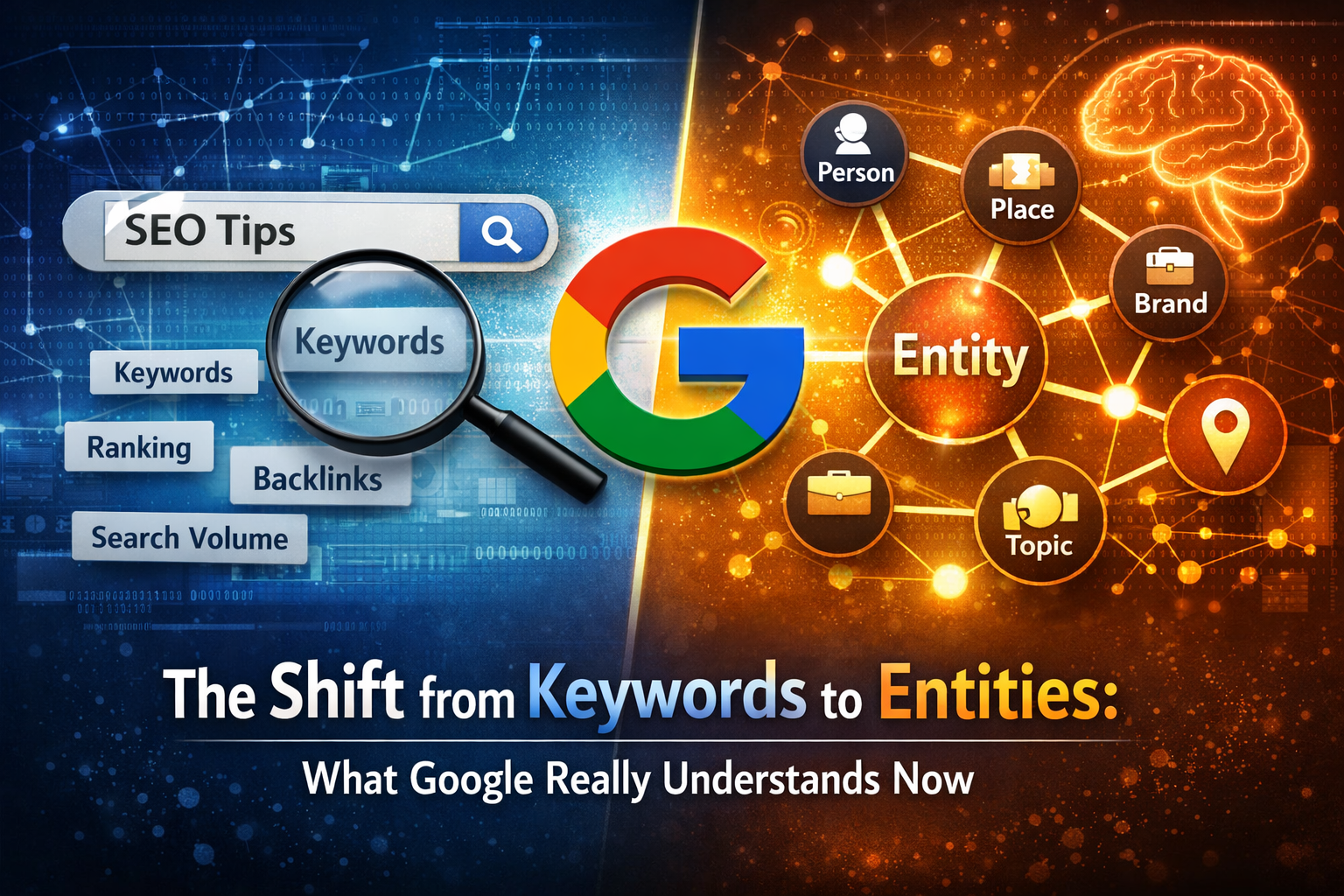
If you’re still obsessing over keywords the way SEO guides told you to five years ago, there’s a good chance you’re missing how search actually works today. You might be ranking for a few terms, but traffic isn’t converting, or worse, it’s dropping without a clear reason. That’s not random. It’s the result of a fundamental change in how Google interprets content.
The shift from keywords to entities isn’t just another SEO trend. It’s a structural change in how Google understands meaning, context, and relationships. And if your strategy hasn’t caught up, you’re effectively speaking a language Google is moving away from.
What Does “The Shift from Keywords to Entities” Actually Mean?
For years, SEO revolved around matching exact phrases. If someone searched “best SEO services UK”, the goal was simple: include that phrase enough times to signal relevance.
But Google no longer relies on string matching alone. Instead, it focuses on entities. An entity is a clearly defined concept or thing, such as a business, person, service, or idea. Google doesn’t just read words; it connects them to real-world meanings.
So instead of seeing SEO services as just a phrase, Google understands it as a service category, linked to concepts like rankings, search intent, technical optimisation, and user experience.
Why Google Moved Beyond Keywords
The shift didn’t happen overnight. It’s tied to updates like semantic search, machine learning improvements, and systems such as Google Knowledge Graph and Google BERT.
These systems allow Google to understand context in a way that wasn’t possible before. For example, if someone searches “how to get more leads from my website”, Google doesn’t just look for that exact phrase. It understands intent. It connects that query to topics like conversion rate optimisation, landing pages, and content strategy.
Real-World Example: Keywords vs Entities in Action
Let’s say two UK agencies publish content about lead generation. The first writes a page repeating SEO services UK throughout the content. It ticks the old SEO boxes but lacks depth.
The second explains how SEO, content, and user experience work together. It discusses site structure, intent, internal linking, and even touches on website design improvements.
Guess which one Google favours?
The second page wins because it demonstrates topical authority. It connects multiple related entities rather than relying on a single keyword. This is where businesses offering SEO Services and Website Design Services can stand out by integrating strategy instead of treating each service in isolation.
How This Shift Changes SEO Strategy
The uncomfortable truth is that many SEO strategies are outdated. Keyword research still matters, but it’s no longer the centrepiece.
What matters now is how well your content answers a topic in full. That means covering related concepts, addressing intent, and structuring information in a way that makes sense both to users and search engines.
If your content is narrowly focused on one keyword, you’re limiting its ability to rank across variations and related searches. On the other hand, content built around entities can rank for dozens or even hundreds of queries because it reflects how people actually search.
The Role of Semantic SEO in the UK Market
In competitive markets like the United Kingdom, this shift is even more noticeable. Local businesses are no longer competing just on keywords; they’re competing on authority.
Semantic SEO is about building that authority. It involves creating content that covers a subject deeply and logically. Instead of writing separate thin pages for every keyword variation, you build interconnected content that signals expertise.
For example, a service page shouldn’t just mention SEO services. It should naturally reference audits, technical SEO, local SEO, content strategy, and analytics. These aren’t keywords to stuff in. They are entities that strengthen relevance.
AEO and GEO: The Next Layer of Search
Search is also expanding beyond traditional results. With Answer Engine Optimisation (AEO), your content needs to directly answer questions in a clear and structured way. This is what helps you appear in featured snippets or AI-generated answers.
Generative Engine Optimisation (GEO) goes a step further. It’s about ensuring your content is understood and used by AI systems that summarise information for users.
In practical terms, this means writing clearly, structuring content logically, and answering real user questions without fluff. If your content is vague or overly keyword-focused, it’s less likely to be selected as a trusted source.
How Website Design Supports Entity-Based SEO
This is where many businesses overlook a critical factor. Even the best content struggles if the website structure doesn’t support it.
A well-planned site architecture helps Google understand how your pages relate to each other. Internal linking connects entities across your site, reinforcing topical authority.
Good design also improves user engagement. If visitors can easily navigate your content, stay longer, and interact with your pages, it sends positive signals to Google. This is why combining SEO with strong website design isn’t optional anymore. It’s a requirement.
Common Mistakes Businesses Still Make
Despite all this, many businesses continue to rely on outdated tactics. They focus on keyword density, create thin content, or ignore user intent altogether.
Another common issue is treating each page as a standalone piece rather than part of a larger content ecosystem. This approach limits your ability to build authority.
There’s also a tendency to chase quick wins instead of building a long-term strategy. But entity-based SEO rewards consistency and depth, not shortcuts.
How to Adapt Without Overcomplicating It
The shift might sound complex, but the underlying principle is simple. Stop writing for search engines and start writing for understanding.
Think about what your audience actually wants to know. Cover the topic thoroughly. Connect related ideas naturally. And make sure your content is easy to read and navigate. When you do that, you’re aligning with how Google already works.
FAQs
What is the difference between keywords and entities in SEO?
Keywords are specific phrases people type into search engines, while entities are concepts or things that Google understands and connects. Entities allow Google to interpret meaning rather than just matching words.
Is keyword research still important?
Yes, but its role has changed. It’s now a starting point for understanding user intent rather than the main focus of optimisation.
How does this affect local UK businesses?
It increases the importance of authority and relevance. Businesses need to demonstrate expertise in their field rather than relying on basic keyword targeting.
Can small businesses compete with larger brands using entity SEO?
They can, especially by focusing on niche topics and providing detailed, high-quality content that larger brands often overlook.
Final Thoughts: Where Most Businesses Get It Wrong
The biggest mistake isn’t ignoring keywords. It’s assuming that keywords alone are enough. Google has moved on. It’s looking for meaning, context, and depth. Businesses that understand this shift gain a clear advantage, while others struggle to keep up. If your current strategy feels like it’s hitting a ceiling, this is probably why.
Ready to Adapt Your Strategy?
If you want your content to rank, attract the right audience, and actually generate leads, it’s time to rethink how you approach SEO. A strategy built around entities, supported by strong content and smart website design, is what delivers results now.
If you’re looking to upgrade your approach, explore how tailored SEO and website strategies can help your business grow in a more sustainable way.